
 Mary Anne
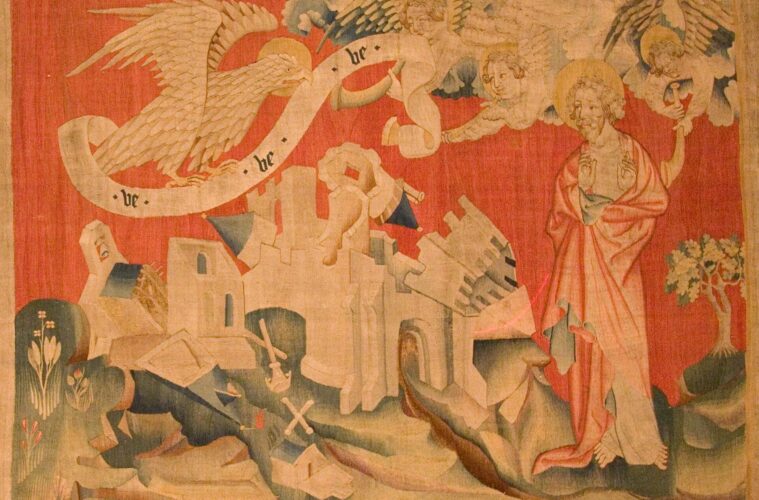
The Tapestry of the Apocalypse, housed in the formidable Château d’Angers in Angers, tells the extraordinary and powerful story of the Second Coming of Christ, his victory over evil, and the end of the world. It is without doubt one of the most impressive tapestries in the world, matching the famous Bayeux Tapestry in Normandy.
View the Tapestry
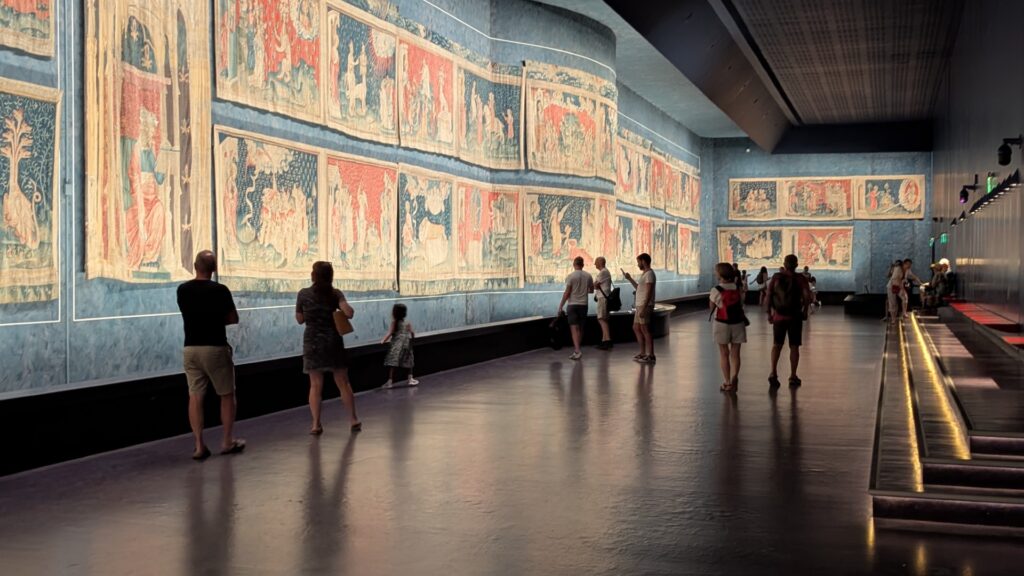
Walk into the large, semi circular room and wait a minute to let your eyes adjust to take in the two rows of images that stretch into the distance.
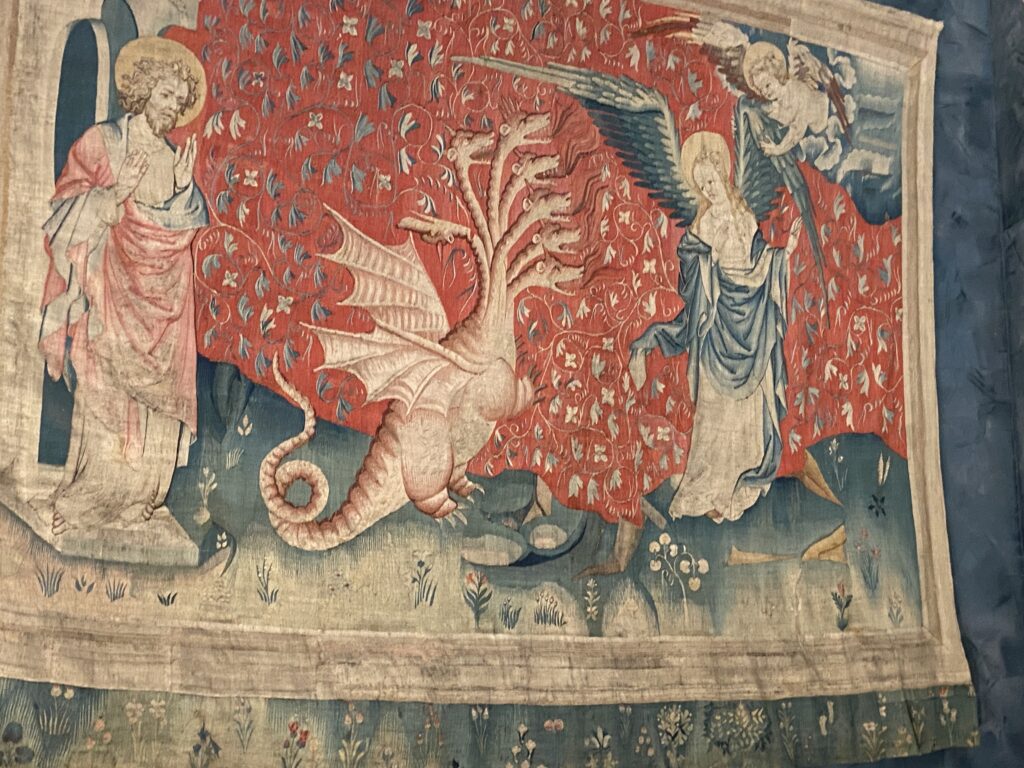
The story is divided into six ‘chapters’ which follow the last chapter of the New Testament of St. John about the Apocalypse. Each of these chapters depicts a figure seated on a dais reading the ‘Revelations’ that you see in the scenes which follow.
The tapestry is firmly anchored in the 14th century when it was woven with references to the life of the time, and to the English – the dreaded enemy of France during the 100 Years War which took place intermittantly between 1337 and 1453.
We might today need some help with the scenes and their significance (check out the audio guide) but to the 14th century mind, the allusions were obvious. Look at the scene where the dragon (France) acknowledges the supremacy of the monster (England) and offers a sceptre with the French fleur-de-lys, the symbol of France, at the top. The scene comes from Revelations 12:1-2:
“And I saw a beast rising out of the sea, with 10 horns and seven heads, with 10 diadems upon its horns and a blasphemous name upon its heads. And the beast that I saw was like a leopard, its feet were like a bear’s, and its mouth was like a lion’s mouth. And to it, the dragon gave his power and his throne and great authority.”
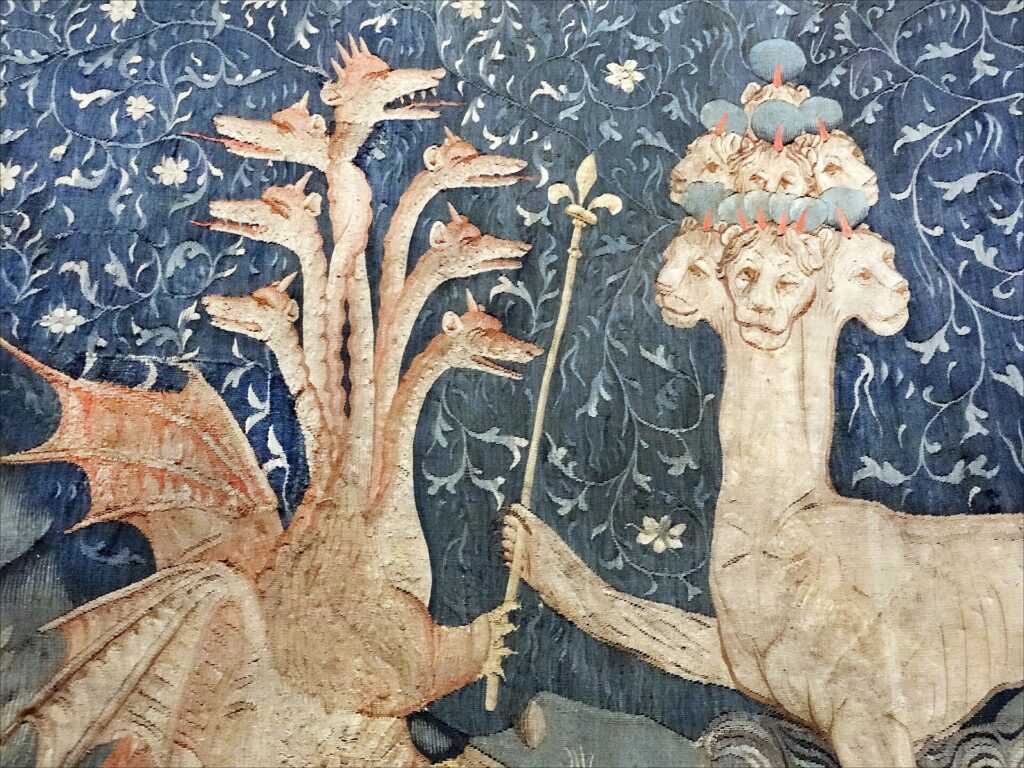
Good versus evil; France versus England.
The Four Horsemen of the Apocalypse
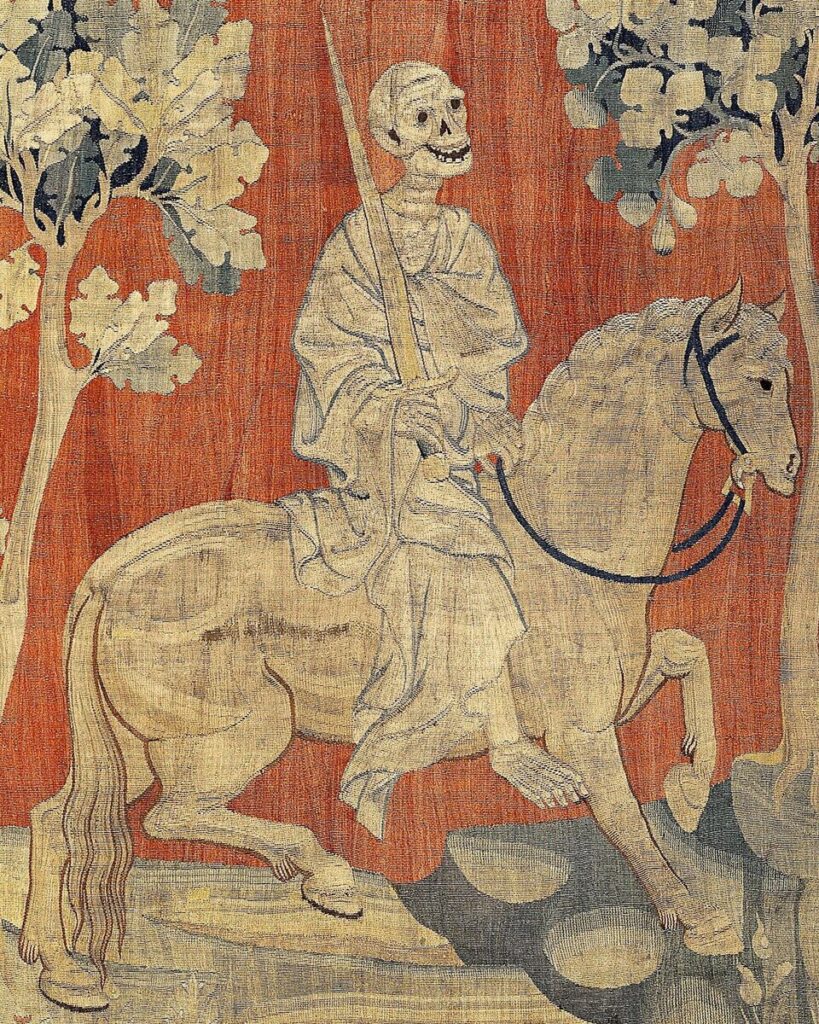
Look at the panels showing the Four Horsemen of the Apocalypse and you’re witnessing contemporary 14th-century France. The Black Horse refers to the famine that devastated communities suffering from the scorched-earth tactics the English army used as they made their way through France. The Pale Horse represents death, the mass casualties of the war and the black death that was ravaging France and the rest of Europe.
The Weaving of the Tapestry
The tapestry was woven in Paris between 1377 and 1382 for Louis I of Anjou. It was designed by Hennequin de Bruges (also known as Jean Bondol) who took the images from an illuminated manuscript belonging to the French King Charles V, the Duke of Anjou’s brother. Two master weavers, Nicolas Bataille and Robert Poincon, oversaw the production which involved around 35 French and Belgian weavers and took over seven years.
The Tapestry Survives
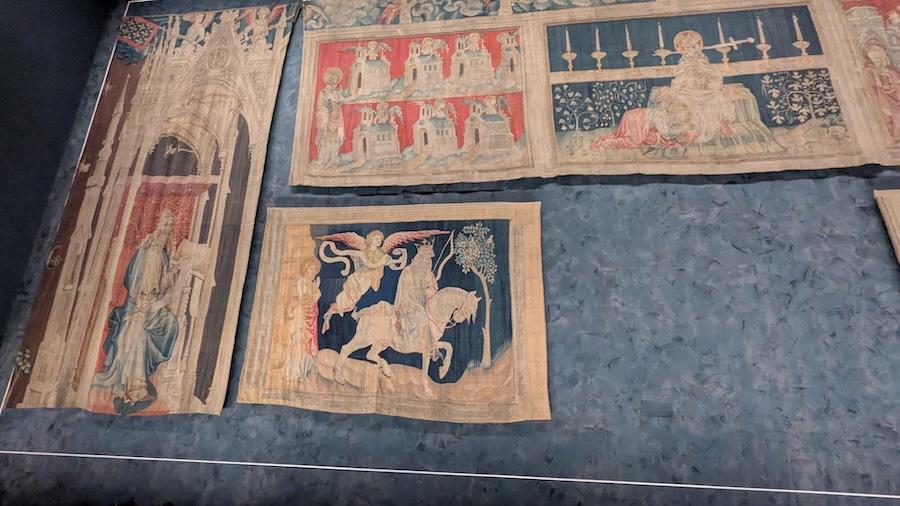
The Tapestry originally measured 133 meters (436 feet) long and six meters (20 feet) high and was displayed in Angers cathedral on special days. In the 1790s, the French Revolutionaries took the tapestry and proceeded to cut it up, using it for floor mats, protection for orange trees and filling holes in buildings.
It’s a miracle that ithis spectacular Tapestry of the Apocalypse has survived. It was all due to one Louis-François Joubert, custodian of the Cathedral of Angers’ treasures who painstakingly searched out the separate panels and had them restored between 1843 and 1870. 16 were never recovered and were probably destroyed. But today it still measures 103 metres long and 4.5 metres high.
UNESCO
In May 2023 the Tapestry was included in UNESCO’s Memory of the World register, joining other French inclusions like the films of the Lumière brothers and the Bayeux Tapestry. It constitutes the world’s largest and oldest surviving set of medieval tapestries, a woven depiction of the illuminated Anglo Norman manuscripts.
Practical Information
Château d’Angers
2 Promenade du Bout du Monde
49100 Angers
Website
Access to the ticket office is via the drawbridge of Château d’Angers
Open
May 2 to Sept 4: Daily 10am-6:30pm
Sept 5 to Apr 30: Daily 10am-5:30pm
December 24 & 31 closes at 4.30pm
Last entry 45 mins before closing time
Admission
Adult €14.00; Concessions €11; Free for under 18 years; Free with the Angers City Pass
The entry ticket gives access to the entire tour route (ramparts, courtyards, gardens, royal residence, chapel, Apocalypse gallery, interpretation trail), as well as to temporary exhibitions.
More Information
French Tapestry from Bayeux to Today
The Bayeux Tapestry Story